

Disaster Flora
What grows in the ruins?

Dearest readers, this month I have some winter rain-inspired musings on disaster flora, the plants that grow in the aftermath of destruction and war. It’s one disaster after another these days—what thrives in such places? I’m also sharing the sign-up for a collage workshop I’ll be co-hosting next month. As always, please “like” this post to give me and the algorithm positive feedback.
After the May 1945 surrender of Germany, after the winter rains drenched what remained of the city of London, residents witnessed a wild resurgence: the craters filled with flowers. They were wildflowers, mostly fireweed, that grow best in disturbed soil. Fireweed, as its name suggests, is among the first to flourish in fire-scorched lands. The bombing had the unintended effect of blooming the city.
The image of destroyed buildings shrouded in wild blooms (as seen in this 1946 footage by British Pathé) became a symbol of London’s destruction and also of its resilience. The blooms attracted the popular interest of the people who lived among them and also the scientific interest of England’s botanists, now presented with a never-before-seen ecology. There arose a new field of study: the botany of war.
London was a ruinscape, a place of rubble and destruction, but it was also strangely beautiful. Fireweed has tall stalks whose tips burst in delicate purple blooms. Its seeds are tiny, enrobed in fine filaments that rid the wind, while the least hint of moisture will cause the seeds to swell and fall out of the air, floating and falling, floating and falling. English botanist Edward James Salisbury wrote that fireweed “enpurpled” London’s rubble with youthful, fresh meadows, as if the city had been erased.1
For London’s residents, fireweed gained another name: bombweed.
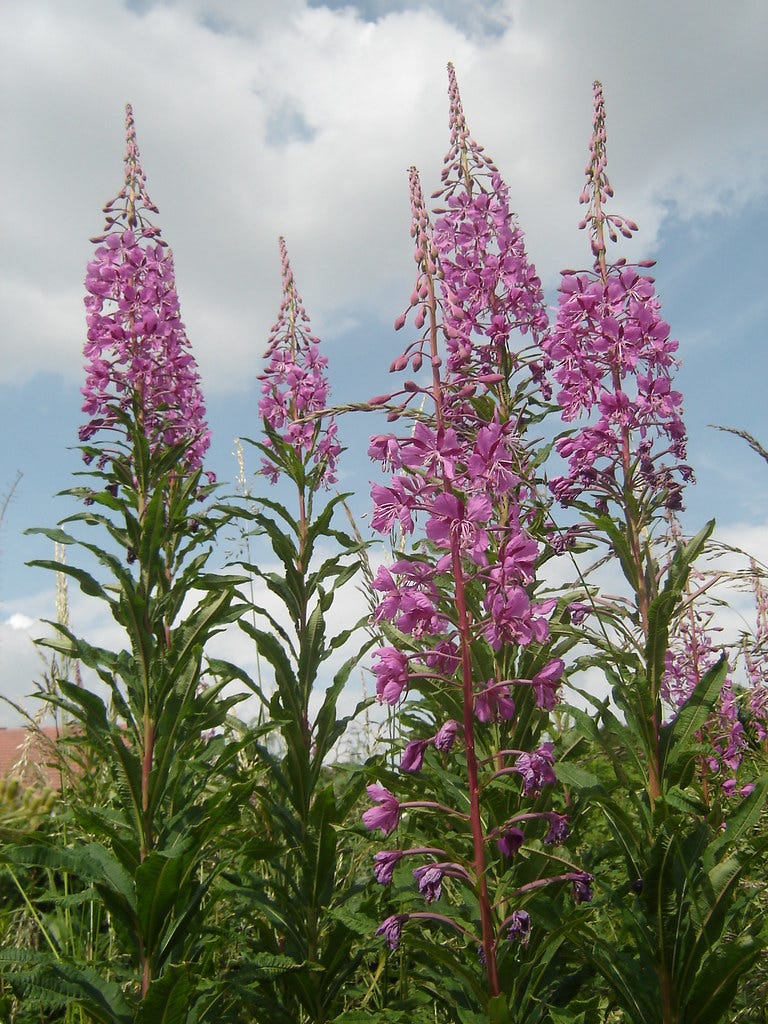
To many, the flowers were symbols of redemption. Cottongrass flowers, another common London weed that grows in rubble, are white and wispy, like a funeral veil, but also the white of innocence, cleanliness, and newness.
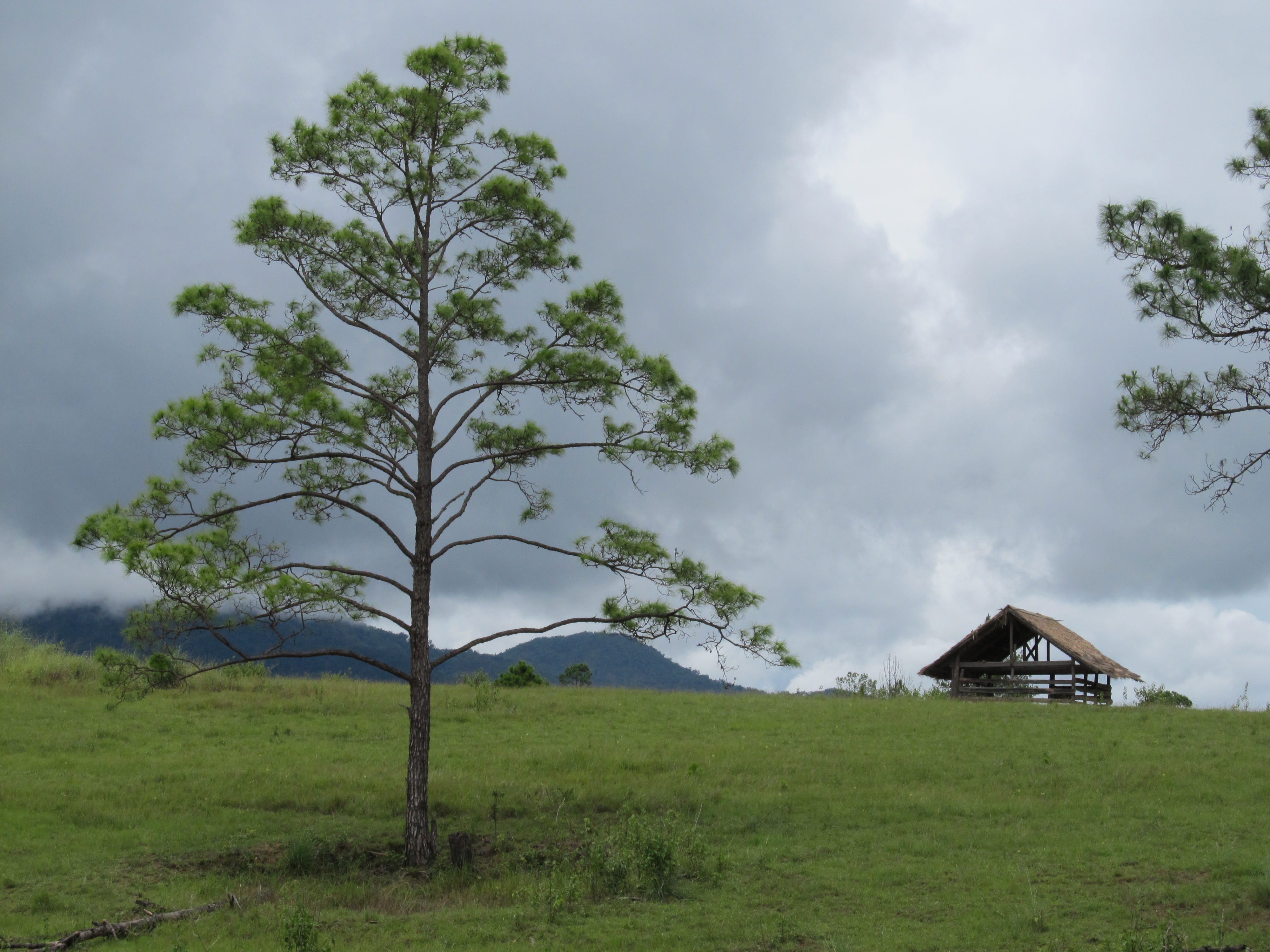
When I was in Laos researching my first two books, I witnessed a similar ecology blooming in the old battlefields of the Vietnam War. Wildflowers grew from bomb craters. Some hosted sapling trees. Areas that had once been jungle were now endless horizons of grass and flower. Mostly, the jungle never grows back.
Modern war seeds similar ecologies wherever bombs fall. Gravity bombs compact the soil around the target site, preventing the regrowth of vegetation and increasing soil erosion. Energetic chemical residues left behind by the blast poison the soil and disrupt the natural processing of nitrogen and other nutrients. These changes to the soil infrastructure prevent most plants from reseeding, especially trees, transforming forests into grasslands. The reduction in canopy cover gives a sunlight boost invasive weeds. Very few plants can thrive in craters and rubble: some grasses, hardy wildflowers, lichens, and mosses.2
The stark landscapes left behind by war resemble zones of glacial sheering and volcanic eruption. Places of both destruction and bare, bald possibility.
Intense air warfare can permanently destroy the webs of life that make a place unique, producing a new postwar ecology that supports far fewer species, and is far less friendly to human thriving. As geographer and designer Seth Denizen writes in his study of London’s war botany, “the discovery that the flora of modernity [is similar to] a glacial or volcanic aftermath should give us pause, because these are places that people in London don’t want to live.”3
War is not a thing that happens on the land, there and then gone. It becomes part of the land. Leaves behind physical traces—in altered landscapes of trench and crater, and also invisibly in toxins that linger in the water, soil, and leaves. These have lasting impacts on plant and animal life, impacts that outlast our memories of violence. They come to appear natural, even beautiful.
The early botanist of war, driven by an understandable desire, were overly optimistic in their search for evidence of postwar urban recovery. The blushing fields of fireweed invited a false image of growth. More recent studies of postwar zones in Southeast Asia and elsewhere show long-lasting drops in land fertility, greater soil erosion, and lowered ecological diversity. Lingering military waste may remain dangerous for decades or centuries, especially in rural areas, producing “fear ecologies,” places where humans and other animals must adapt themselves to constant threat. We now know that in most postwar zones, recovery is a privilege of the urban (often White) industrial elite.4
I’ve written about similar ecological effects of war in rural America in the toxic shadow of military bases and the ruins of explosives factories.
For fireweed and other disaster flora, war is an opportunity for super bloom. While the display may be impressive, each bloom is the exception, the survivor, the conqueror. Instead of a tale of resilience, fireweed shares a more disturbing and profound truth about life at the margins of the livable. There are selfish things that we do when pushed to our extremes. Fireweed and other disaster flora are opportunistic conquerors of ravaged lands where everything else has died. On closer inspection, their spare ecologies expose the fantasy that we, like the fireweed, might thrive upon disaster.
A Personal Note
Winter rain is drenching the Bay Area. I remind myself that these are the storms that make the spring blooms possible.
I feel like that tree growing out of the bomb crater. I’ve been growing where I am planted, in a mostly desolate field, without the privilege of considering where I am or how I got here. After turning my manuscript in last month, I decided to take a break from work. I’m approaching this break as an experiment to determine my physical baseline. I got sick nearly three years ago but have always been working on one project or another. This is the first time there’s been a gap between projects. What is my actual baseline when I don’t work? What are my actual capacities when I don’t push myself?
During this period of rest, I have been collaging and making art. I recently had a piece published in the zine together in sacred grief, which you may purchase here. Collage is a practice of making the unconscious visible--ideas and feelings that exist at the margins of myself. It is unclear to me exactly how collage “works,” if such a question is even worth answering, but it sometimes feels like making collage makes things or feelings real. Not a representation of a thing, but the thing itself. Like waking up and remembering a dream. Remembering makes the dream real.
For those who want to explore this with me, I will be co-hosting a collage workshop on March 14th at Moon Landing, a studio art space in Oakland, California. My friend Kelly Donohue and I will guide you through a meditation and psycho-collage experience. Sign up here.
I hope to see you there!

Denizen, Seth. 2020. “The flora of bombed areas (an allegorical key).” In The Botanical City, edited by Matthew Gandy and Sandra Jasper. Berlin: Jovis Publishers. Pages 38-45. Quoted on page 38; For a German perspective, see: Lackmund, Jens. 2003. “Exploring the City of Rubble: Botanical Fieldwork in Bombed Cities in Germany after World War II.” Science and the City (2, 18). Pages 234-254.
Brauer, Jurgen. 2009. War and Nature: The Environmental Consequences of War in a Globalized World. New York: Altamira Press. Pages 46-47, 58, 70-71; Kuperman, Roman G. et al. 2009. “Effects of Energetic Materials on Soil Organisms.” In Ecotoxicology of Explosives, edited by Geoffrey I. Sunahara, Guilherme Lotufo, Roman G. Kuperman, and Jalal Hawari. New York: Taylor & Francis Group. Pages 35-76.
Denizen, 44.
Lin, Erin. 2024. When the Bombs Stopped: The Legacy of War in Rural Cambodia. Princeton: Princeton University Press. See page 62 for a discussion of fear ecologies.